
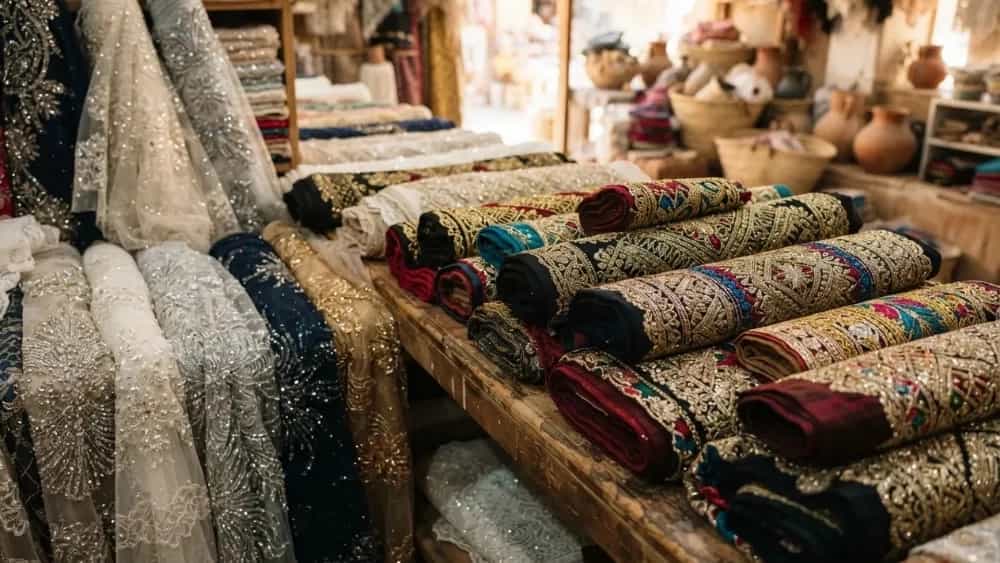
Remkan village in the center of Qeshm Island is the main trading center for imported and traditional southern textiles, which distributes a wide variety of worked lace fabrics, majlis guipure and cool local fibers directly. Sarai Seleh Lace fabric in this stock market provides the chain of access to high-quality foreign and local fabrics and offers purchase by the yard and meter based on the exact test of grammage, color stability and beading quality. Our surveys in Ramkan fabric booths prove that the direct procurement of fabric from this source reduces the cost of traditional and Masonic clothing by 25 to 40% compared to central markets.
Buying fabric in Qeshm Island is noticeably different from traditional markets in central cities. The sultry air of the south, the local clothing culture with women's pants and kandourahs, and Remkan's proximity to the sea routes of the Persian Gulf have turned this region into a storehouse of fine and heavy textiles. In the following, the methods of separating the original material, the structure of the selection of elaborated cloths, and the criteria for recognizing native fabrics of the south are examined.
The geography of Ramkan market and the advantage of Qeshm Island textiles
Ramkan is not just a geographical area, but the beating heart of cloth clearance and distribution in the island. Buyers disappointed by Darghan or City Center will head straight to Ramkan Fabric Bazaar for unlimited sizes or bespoke work in Dubai and Oman.
The qualitative distance of imported fabrics from the Persian Gulf with domestic markets
Most of the loads entering Ramkan are manufactured by India, Korea, China and ordered by the Arab countries of the Persian Gulf. Our field experience in touching and cutting these materials shows that the nets used in the laces ordered by Emirates have a resistant elasticity and do not shrink or burn locally against the heat of the steam iron. Due to the high density of the base thread, these fabrics do not suffer from splitting of the sewing line under the industrial sewing machine.
Reduction of intermediary and final price in the free zone
The absence of heavy domestic intermediary tariffs has made Sarai Salih Lace fabric supply embroidered materials at a commercial rate. In bulk orders for manufacturers and masons, the freight is carried out from Qeshm to other provinces through reliable Ramkan carriers with anti-humidity packaging to preserve the health of the stones and flakes until the destination.
The variety of dress and lace fabrics in Serai Selah Lace Fabric
Expertise in the supply of lace requires a deep knowledge of the field of lace, silk threads and the type of attachment of crystals on the fabric. The correct fall of the evening dress is completely dependent on the weight and substratum of these textiles.
Worked laces, crystals and pearls
Heavy majlis laces are heavy due to having cut stones and detailed embroidery. In the examination of these fabrics, the knotting thread behind the lace should be checked; If the stones are attached with hot glue, they will fall off after washing or ironing, but in the models offered in Selah Lace, all the beads and crystals are woven into the net by means of fine wire or blind stitches.
Guipure, crepe lamé and lamé sand
For customers who are looking for a smooth shine or regular slim and geometric patterns, Turkish and Dubai guipure with high stability are an ideal option. Unlike weak samples, the elastic lame crepes in Ramkan do not lose shine and do not release shiny particles on the skin or the surrounding environment due to daily friction.
Originality and elegance in local and traditional fabrics of Hormozgan
Traditional clothing of southern women is a mixture of textile engineering adapted to warm climates and the art of needlework. The local fabrics available in Remkan have unique physical characteristics that distinguish them from ordinary summer fabrics.
Val, chit and pure cotton thread for kandura
Traditional Kandoureh clothing requires a fabric with gentle shedding and maximum breathability against heat. The supplied cotton and Indian wale fabrics allow air to easily pass through the woven layers and do not become heavy or smelly when in contact with body sweat. These fibers withstand repeated washing without changing their dimensions or asymmetric "water runoff".
Shaki fabrics, embroidery and zaribaf
Production of baggy pants and southern laces requires strong woven fabrics. Worked metal and silver qualities should not create an annoying roughness. Zaribaf fibers are woven into Sarai Selah lace fabric with a soft silk thread foundation so that they do not fall apart during the traditional hand embroidery stitches.
An experimental guide to buying and maintaining fabric in different climates
Tailors and buyers who transport fabric from the humid climate of Qeshm to the dry areas of the Iranian plateau, should consider several operational points:
- Before cutting natural fiber fabrics, the fabric should be immersed in cold water for 30 minutes to ensure its dimensional stability.
- Heavy embroidery laces should never hang on narrow hangers; The pull of gravity causes the form of the net to be deformed in the shoulder area, and their storage should be done in the form of a tube in a fabric cover.